
Authors: Francesco Reda, Marcella Salvatore, Sergio Balestrieri, Salvatore Formato, I Komang Januariyasa, Mario Iodice, Fabio Borbone, Marco Piccardo and Stefano Luigi Oscurato
Journal of Physics: Photonics, Vol. 8, Article number 3 (2026)
Abstract
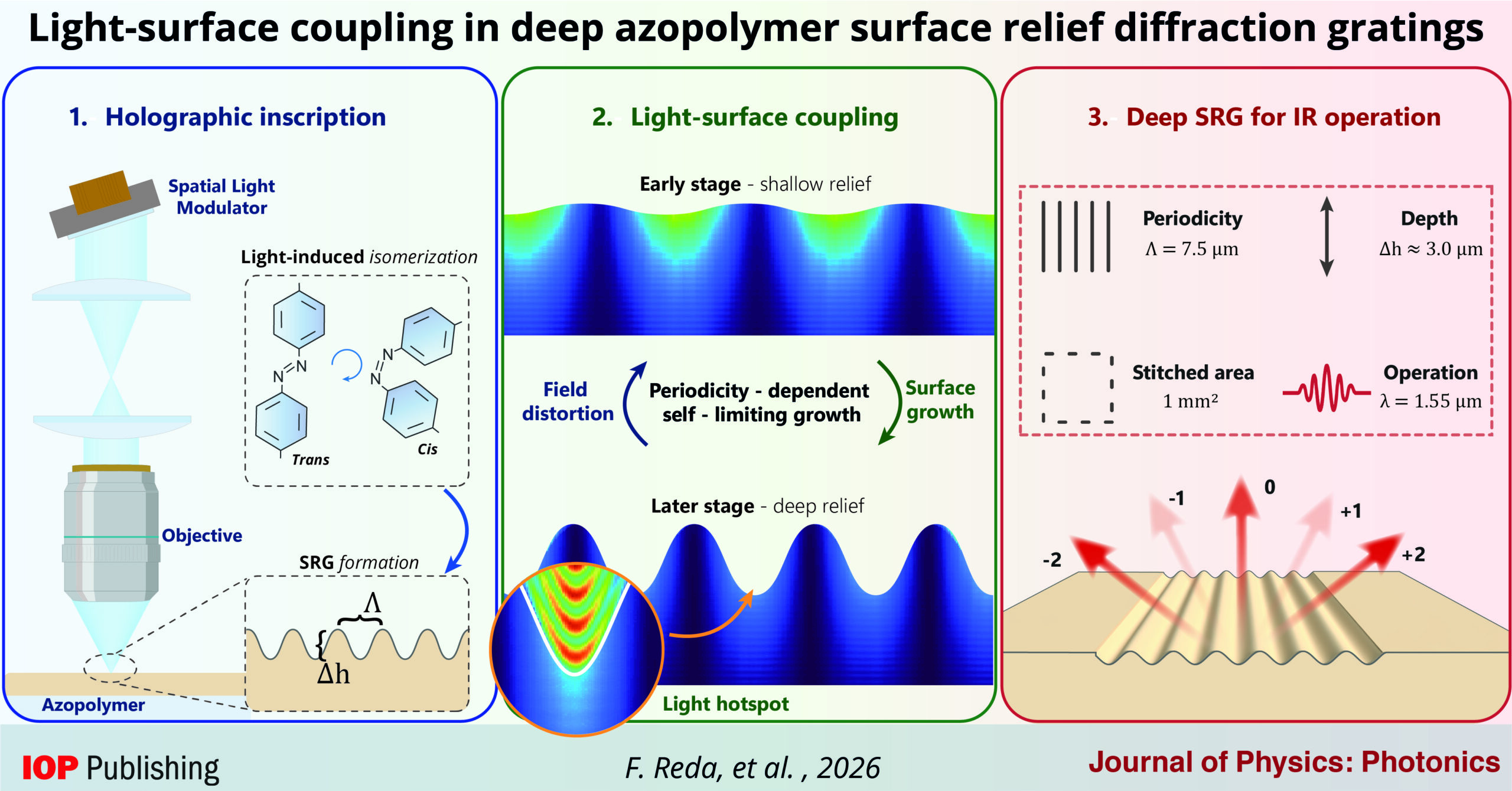
Surface relief gratings (SRGs) are fundamental diffractive elements for optical wavefront control, but in azobenzene-containing polymers their inscription at large modulation depths is limited by growth saturation and profile distortions, which hinder efficient operation at infrared (IR) wavelengths. Here, we develop a quantitative optical modeling framework that combines Fresnel propagation, vectorial focusing, and finite-element electromagnetic simulations to describe how the writing field interacts with the evolving azopolymer surface during holographic inscription. The analysis shows that increasing surface modulation progressively reduces the effective optical driving force for further growth through the combined action of periodicity-dependent pattern reconstruction and relief-induced perturbation of the writing field. Experiments performed on SRGs with different periodicities reveal the same periodicity-dependent saturation trend predicted by the simulations. Within the investigated parameter range, a periodicity of 7.5 μm provides the best compromise between achievable depth, profile fidelity, and diffraction angle. Under these conditions, we inscribe near-sinusoidal SRGs with modulation depths approaching 3 μm in a single all-optical step, and, using a stitching strategy, extend the patterned area to 1 mm2 while preserving modulation-depth uniformity. This enables an azopolymer-based grating operating at the telecommunication wavelength of 1.55 μm. These results establish a quantitative framework for understanding deep-SRG inscription limits in holographically written azopolymer gratings and provide practical design rules for reconfigurable IR diffractive photonics.
Read the article: https://doi.org/10.1088/2515-7647/ae8b64
Open Data: https://doi.org/10.5281/zenodo.21263517.
Open Code: https://doi.org/10.5281/zenodo.21221860.
More from the group: https://scholar.google.com/citations?user=OxnOrTcAAAAJ&hl=it&oi=ao