
Authors: Marcella Salvatore and Stefano Luigi Oscurato
Journal of Physics: Photonics, Vol. 8, Article number: 3 (2026)
This article, published in Journal of Physics: Photonics, is closely connected to the scientific vision behind Hypermash, while addressing a broader objective. It aims to provide a common conceptual ground for different communities working on azomaterials, structured light, holography, photomechanics, soft matter, and flat optics.
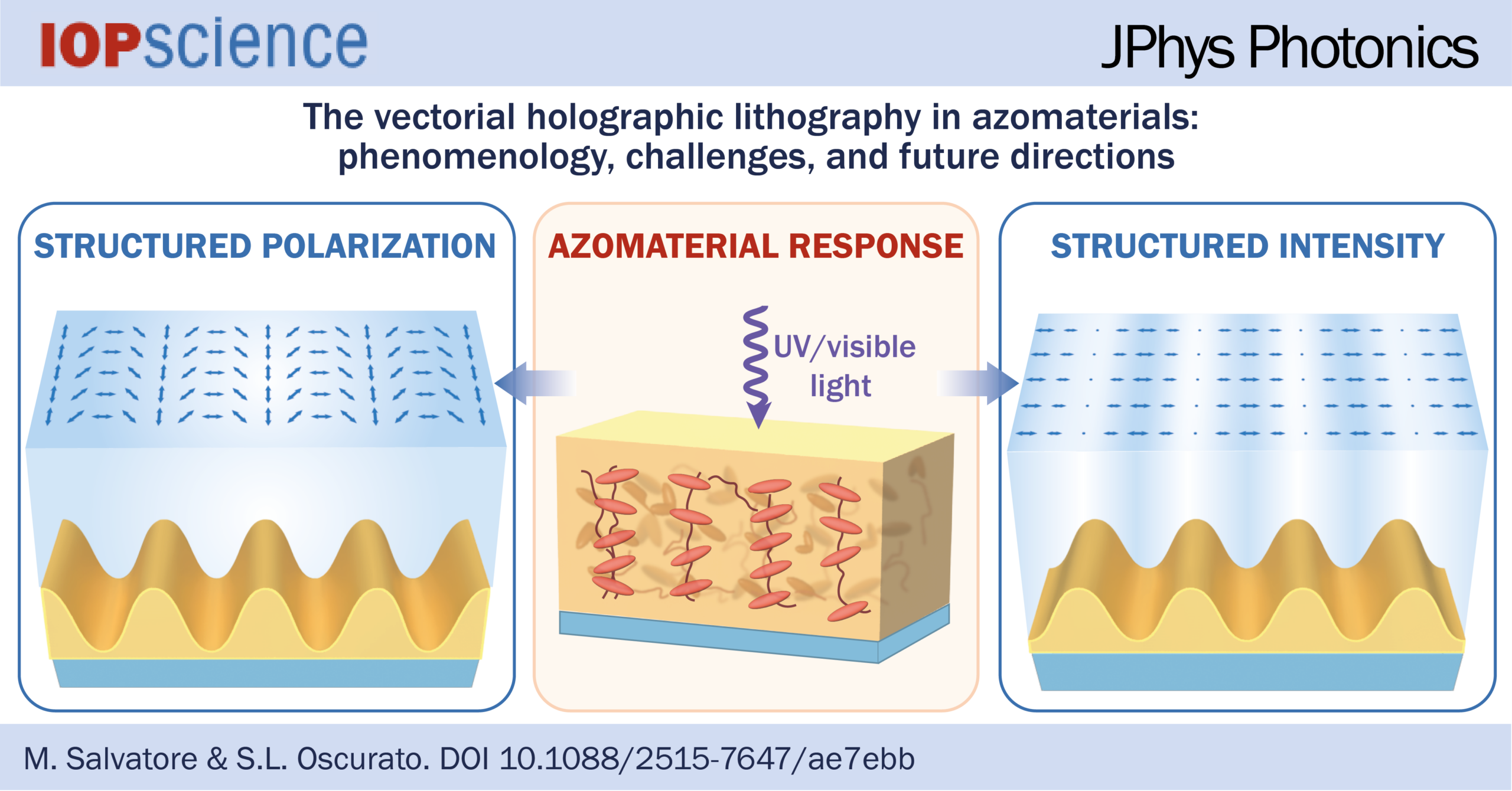
At the center of the Perspective is the indissoluble link between azobenzene-containing materials and vectorial holography. Azomaterials are unique light-responsive systems because they do not respond only to the intensity of light. Through azobenzene photoisomerization and photo-orientation, they can transduce the vectorial structure of optical fields into molecular reorientation, anisotropic stress, mass migration, and surface relief formation.
This coupling has played a crucial historical role in the development of polarization holography and remains highly relevant in the current context of all-optical holographic lithography of azopolymer surfaces. By combining azopolymer films with digital holography and spatial light modulation, structured optical fields can directly write, erase, and reconfigure surface topographies without masks, molds, or post-exposure chemical processing.
The Perspective organizes the phenomenology of vectorial holographic lithography around two limiting regimes. The first involves surface deformation driven by structured polarization fields at nearly uniform intensity. The second concerns relief formation driven by structured intensity fields under nearly uniform polarization. Both regimes are discussed within the emerging Viscoplastic Photo-Alignment framework, which links molecular photo-orientation to light-induced anisotropic stress pathways and macroscopic material transport.
The article also looks toward future scenarios that are central to the Hypermash vision. In particular, we discuss how the field may evolve from conventional intensity-based holographic patterning toward lithographic strategies based on fully structured light, where multiple degrees of freedom are co-designed, including polarization, intensity, wavelength, phase, and time. Such higher-dimensional optical control could open new routes to programmable surface morphologies, dynamic topographies, and multifunctional photonic interfaces.
Several challenges remain before this potential can be fully exploited. These include a deeper understanding of nonlinear morphological response, predictive models connecting optical fields to final surface shapes, inverse-design strategies for complex vectorial light fields, in-situ optical metrology for real-time feedback, and scalable implementations over large areas.
Read the article: https://doi.org/10.1088/2515-7647/ae7ebb
More from the group: https://scholar.google.com/citations?user=OxnOrTcAAAAJ&hl=it&oi=ao